Estospaces case study
00 Overview
A property platform for India and the UK: my role, the system, the decisions behind it and the evidence.
I am Co-founder and Technical Lead (May 2025 to now). The production environment passed 72 of 72 smoke checks after each of 11 releases (launch-readiness, October 2026). The platform has not launched publicly, and production is offline as of November 2026; the screens on this page are captures from the dev environment with test data.


01 Role
My role
- I decided
The architecture: seven Go services on Cloud Run with a database each, a shared Go library, a React web app and a Flutter Android app, with the infrastructure defined in Terraform. Also the written rules (RULES.md) that every change goes through.
- Teammates built
The first service scaffolds in February 2026, the first auth pass in
core-service, the first Flutter scaffold and the estospaces.co.uk landing site. - AI agents typed
Most of the remaining code, as Claude Code and Codex sessions that I specified and reviewed. Most commits come from the bot account the agents commit as.
- I led
A team of 6 to 8: engineering interns, QA, design and marketing. I interviewed 50+ letting agencies to shape the product.
02 Architecture
The system
The web app talks to seven Go services on Cloud Run. Each service owns its PostgreSQL database. Services never query another service's database: they refer to each other's records by ID and call each other over HTTP with service tokens.
estospaces-web
- SubdomainRouterRole and domain routing
- Auth/session contextAccess + refresh lifecycle
- User workspaceSearch, saved homes, Fast Track, docs, messages
- Manager workspaceDashboard, properties, leads, Fast Track, verification
- Admin workspaceUsers, verifications, tickets, platform ops
- Frontend service modulesfetch/axios adapters
The router sends each request to the auth context and to one of the three workspaces. The workspaces call the backend through the frontend service modules; calls to payment-service were hidden at this phase.
Cloud Run backend services
- core-serviceAuth, users, properties, leads, verification
- booking-serviceApplications, viewings, contracts, Fast Track
- search-serviceSearch logs, saved searches, discovery
- media-serviceUploads, signed URLs, document media
- messaging-serviceChat, support tickets, conversations
- notification-serviceNotification records and delivery
- payment-servicePayments and invoices, hidden in the UI at that phase
All seven services use Cloud SQL PostgreSQL, and media-service also uses the Cloud Storage bucket. Secret Manager supplies the web app and the services, and the services write to Cloud Logging and Monitoring.
Data and platform
- Cloud SQL PostgreSQL
- Cloud Storage media bucket
- Secret Manager
- Cloud Logging + Monitoring
03 Decisions
Decisions and trade-offs
-
Cloud Run, not Kubernetes
Lower operational overhead and a better cost fit for the 1,000 to 2,000 users the design was sized for.
Cost: less control over scheduling and networking than a cluster would give.
-
Minimum instances at zero
Keeps dev and production inside the combined budget of INR 15,000 to 18,000 a month set in the July 2026 design.
Cost: cold starts. The first request after idle took about 6 s in the October load test. The written trigger for raising it is a measured cold-start impact.
-
A database per service
Each service owns its data and deploys on its own.
Cost: no foreign keys or joins across services. A record in another service is referenced by its ID.
-
One web app for users, managers and admins
The same React app serves app.estospaces.com and admin.estospaces.com with subdomain-aware routing, so there is one release instead of two.
Cost: role checks have to hold in every route. The backend enforces them; the UI guards are convenience only.
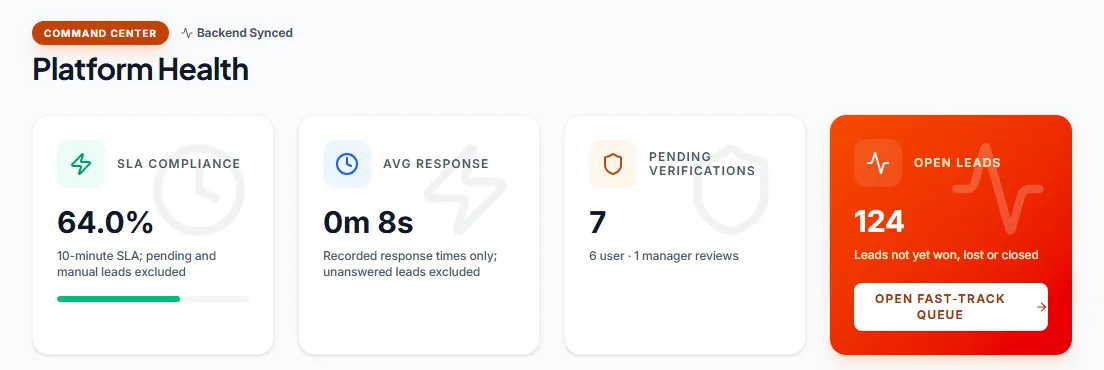
The admin console, served by the same React app as the seeker and manager workspaces in the worked example below. QA pass of 6 to 8 October 2026, test data.
The reasons come from the "Known design decisions" table and the goals of the July 2026 architecture document; the cold-start figure comes from the October 2026 launch-readiness report.
04 Worked example
Worked example: Fast Track
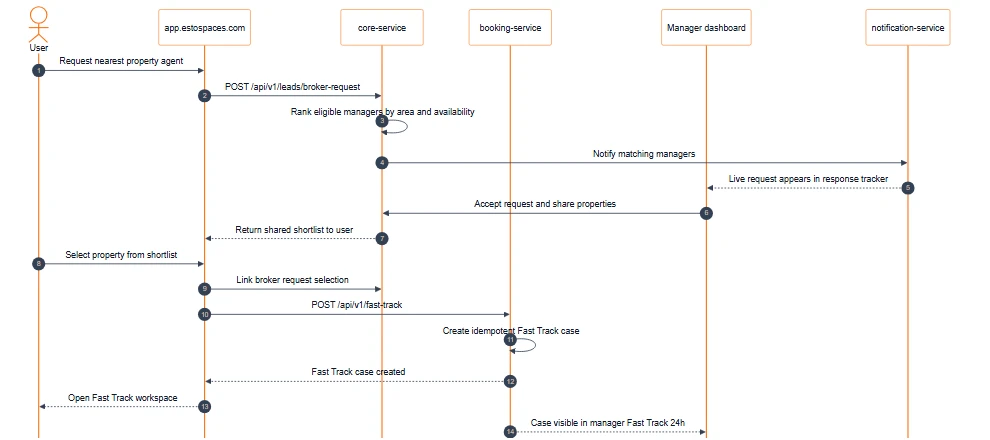
A seeker asks for the nearest agent. core-service ranks eligible managers by area and availability and notifies them. A manager shares a shortlist, the seeker picks a home, and booking-service opens a Fast Track case, created idempotently. The case then moves through six stages: selected, documents, viewing, decision, agreement and handover. The first three screens follow one synthetic request (Chennai, 600094) through the QA pass of 6 to 8 October 2026 on the dev environment; the fourth is an earlier test case from the same pass.
-
- User to app.estospaces.comRequest nearest property agent
- app.estospaces.com to core-service
POST /api/v1/leads/broker-request
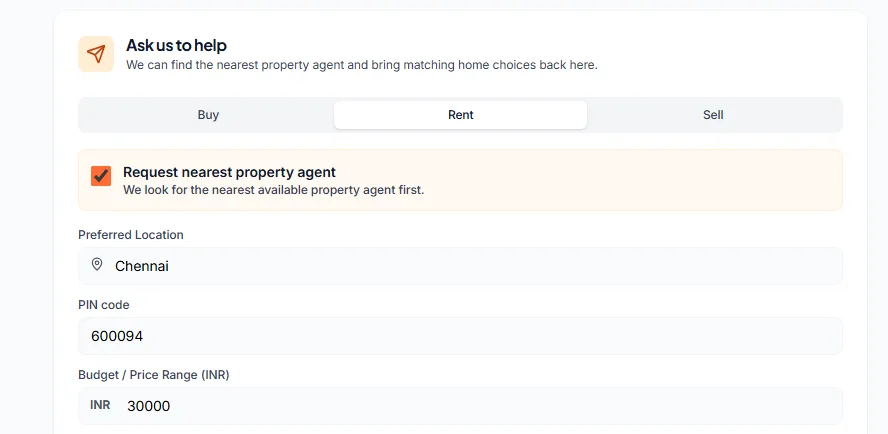
The seeker asks for the nearest agent. -
- core-serviceRank eligible managers by area and availability
- core-service to notification-serviceNotify matching managers
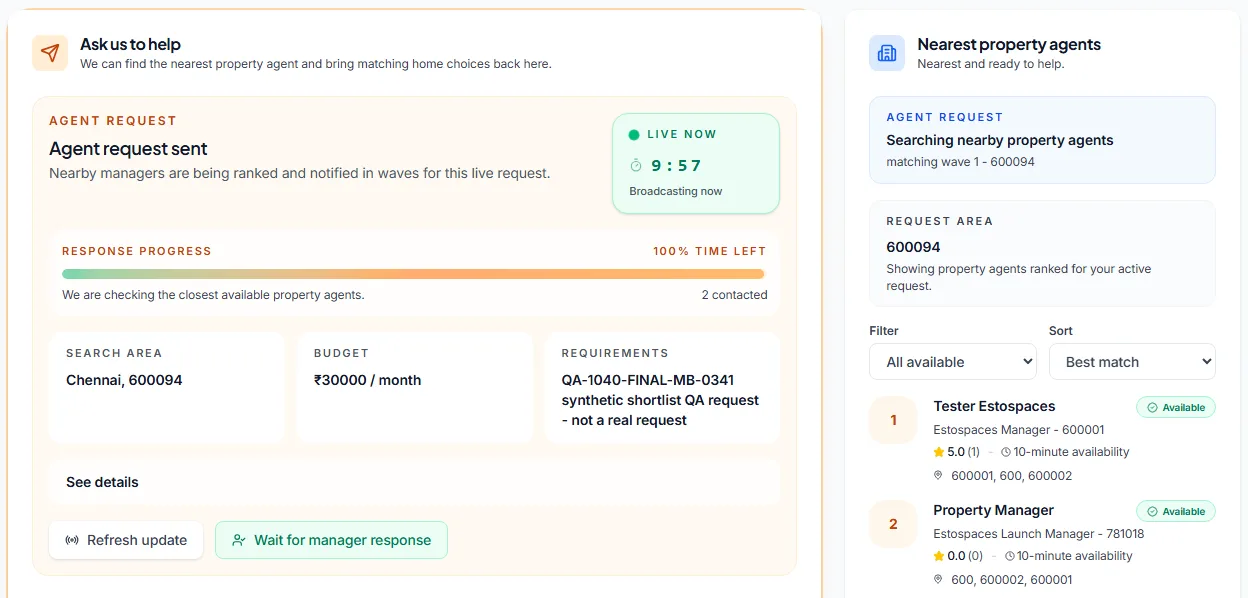
core-serviceranks the eligible managers by area and notifies them in waves. -
- notification-service to Manager dashboardLive request appears in response tracker
- Manager dashboard to core-serviceAccept request and share properties
- core-service to app.estospaces.comReturn shared shortlist to user
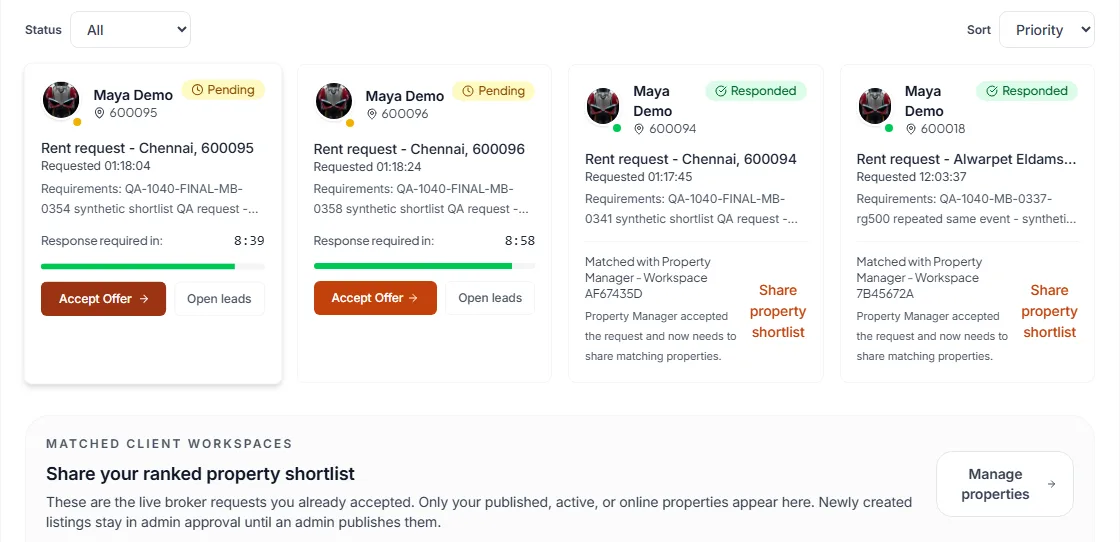
The manager's live tracker: the same request, Chennai 600094, is accepted and now waits for a shortlist. -
- User to app.estospaces.comSelect property from shortlist
- app.estospaces.com to core-serviceLink broker request selection
- app.estospaces.com to booking-service
POST /api/v1/fast-track - booking-serviceCreate idempotent Fast Track case
- booking-service to app.estospaces.comFast Track case created
- app.estospaces.com to UserOpen Fast Track workspace
- booking-service to Manager dashboardCase visible in manager Fast Track 24h
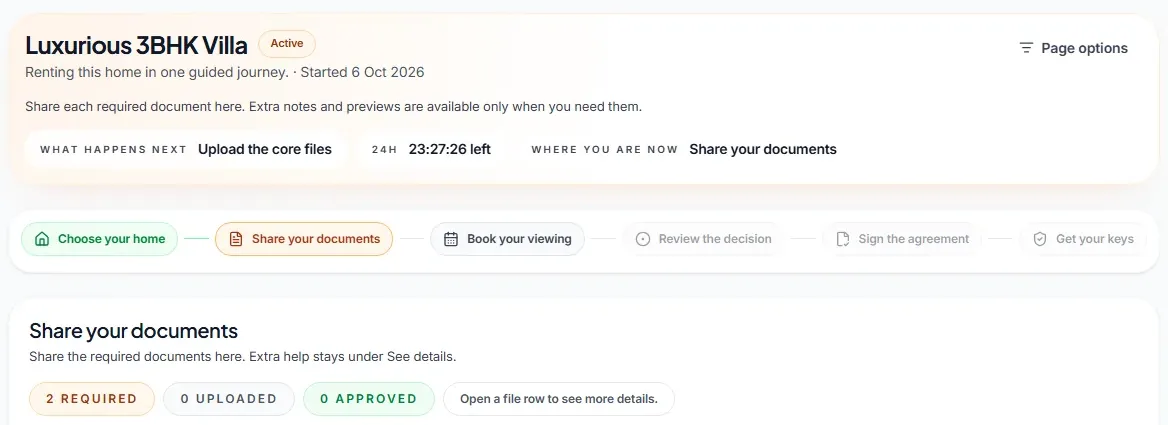
A Fast Track workspace as the seeker sees it, here an earlier test case at the documents step.
Steps from the sequence diagram in the architecture document. Original diagram
Status changes use a compare-and-set update, so two concurrent decisions cannot both land. The excerpt below is that guard. A PostgreSQL race test runs a manager's rejection and a sale closure at the same moment and checks that each application is closed exactly once.
// Compare-and-set on the status read above so two concurrent decisions cannot both land (MB-0496). result := s.db.WithContext(ctx). if result.Error != nil { return nil, result.Error } if result.RowsAffected == 0 { return nil, ErrApplicationStatusChanged }Model( &Application{}). Where( "id = ? AND status = ?", app.ID, app.Status). Updates( updates)
booking-service, internal/bookings/service.go , lines 1525 to 1532 on main at f707fdd (23 October 2026), verbatim. The race test is TestPostgresDecisionRejectionRacesCompetingSaleClosure in fasttrack_postgres_integration_test.go .05 Evidence
Claim, mechanism, evidence
-
Payments are verified and idempotent
Razorpay subscriptions in INR and GBP. Webhooks are verified with HMAC and processed idempotently under row locks. The payment service signs short-lived Ed25519 permits that the other services check before any plan-limited action.
Two tests in
payment-servicereplay a signed webhook and send a bad signature. The first expects one stored receipt after two deliveries; the second expects a 401 and nothing stored.first := request() if first.StatusCode != fiber.StatusAccepted { t.Fatalf(
"first webhook status = %d", first.StatusCode) } second := request() if second.StatusCode != fiber.StatusAccepted { t.Fatalf("duplicate webhook status = %d", second.StatusCode) } var count int64 if err := db.Model(&OrdinaryWebhookReceipt{}). var rows []OrdinaryWebhookReceipt _ = db.Find(Where( "event_id = ?", "evt_handler_replay"). Count( &count). Error; err != nil || count != 1 { &rows). t.Fatalf(Error "expected one durable receipt, count=%d err=%v rows=%+v", count, err, rows) }payment-service,internal/, lines 33 to 46 on main at 40b44ad (9 October 2026), verbatim, frompayments/ razorpay_ ordinary_ webhook_ handler_ test.go TestOrdinary. The bad-signature test isWebhook Handler Queues Verified Event And Is Replay Safe TestOrdinary.Webhook Handler Rejects Bad Signature Without Persistence 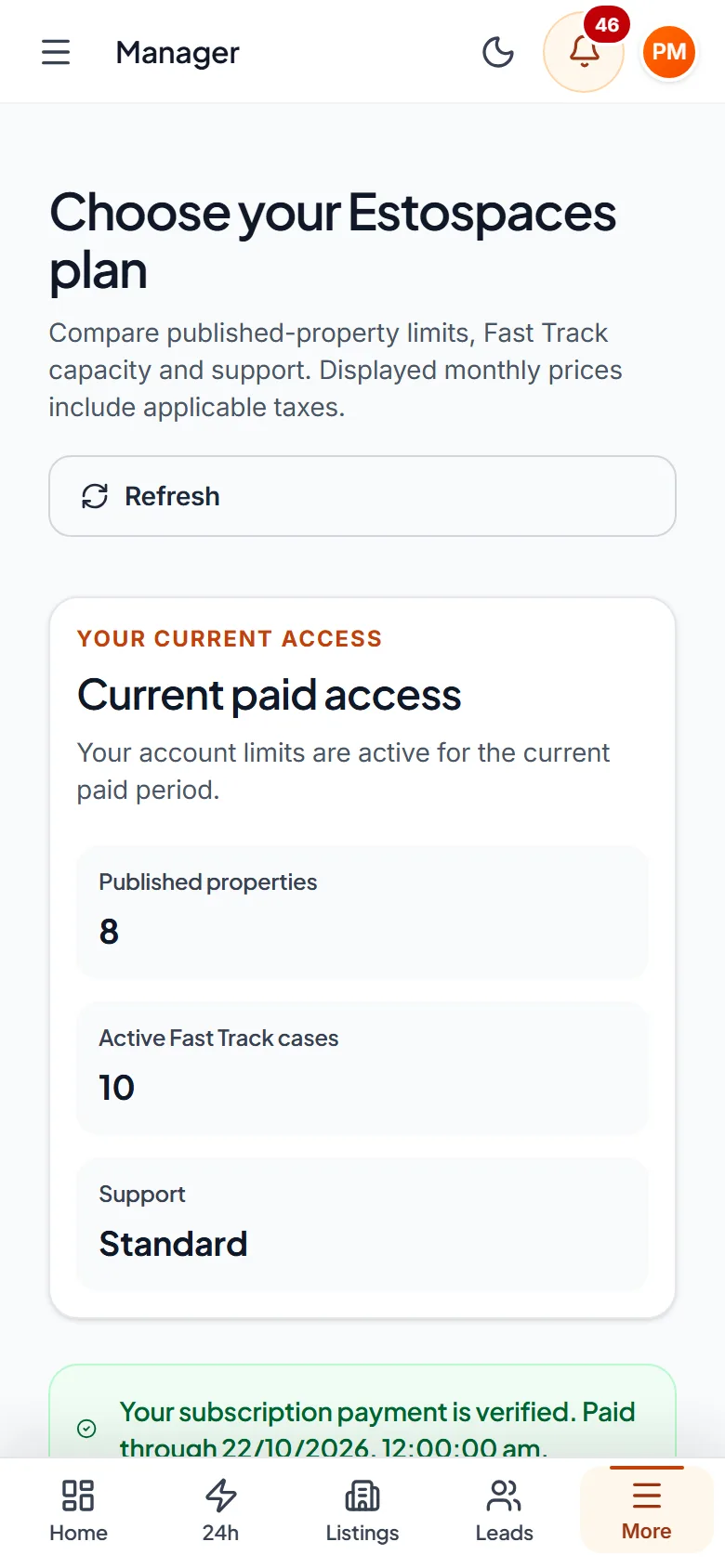
Paid access after a verified payment. 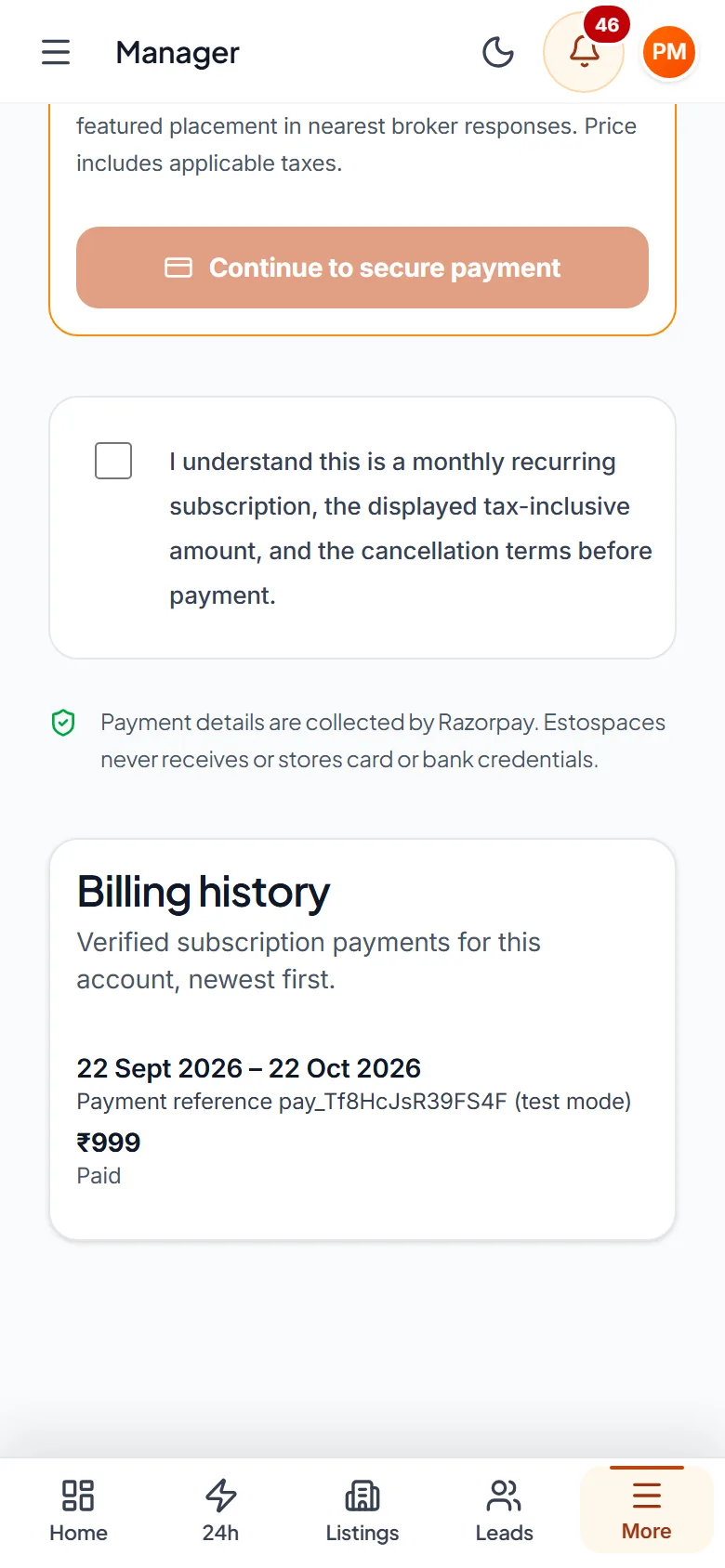
Billing history: Rs 999, paid, with the payment reference marked test mode. What the manager sees after a verified payment, at phone width: a Razorpay test-mode payment, no real money.
-
The backend is Go, one database per service
Seven services on Fiber, GORM and pgx, plus a shared library: about 330 REST endpoints. Booking and payment state changes use compare-and-set updates, row locks and advisory locks.
About 2,100 Go tests, run with the race detector in CI, including PostgreSQL integration tests. Counted on the latest branches, November 2026.
-
Web and mobile are tested like the backend
A role-based React 19 app in strict TypeScript for seekers, managers and admins, and a Flutter Android app for seekers and managers.
About 2,650 web unit tests, about 80 Playwright checks and axe accessibility audits.
About 2,060 Flutter tests and 74 golden images.
-
Releases are gated and can be rolled back
Infrastructure is Terraform: 11 modules across dev, staging and prod. CI runs CodeQL, gosec, govulncheck, Trivy and gitleaks. Deploys go out as a canary to 5% of traffic, then to 100%, with rollback points.
Before the billing schema change I ran a backup and restore drill on a cloned database and kept a zero-traffic rollback revision ready. Production smoke passed 72 of 72 after each of 11 releases (launch-readiness report, 14 October 2026). Production is offline as of November 2026.
-
A basic load test passed on dev
A k6 run in Cloud Build. The web tier served 50 requests a second for two minutes with a p95 of 41 ms. The search and core APIs measured a p95 of 62 ms at 1.5 requests a second and 36 ms at 1.3, the most one test machine's rate limit allows. A burst from 30 parallel clients (12,996 requests) returned only 200s or rate-limit 429s.
Launch-readiness report, section 5. Many-user capacity is not measured yet; that needs several client IPs.
-
Bugs were found and fixed before sign-off
The launch review went through 31 tester tickets and 88 QA bugs. It found no P0, one P1 and eleven P2 bugs; all were fixed and released. The P1 (#691): the web app merged agent requests with the same brief made within 10 minutes and kept the more advanced one, so a new pending request was hidden behind an older matched one in the manager queue. Distinct requests are no longer merged.
Launch-readiness report, 14 October 2026, sections 1 and 3 (web pull request 373, merged 11 October 2026, with regression tests).
test(
'#691: a new pending request is not hidden behind an older matched request with the same brief', () => { const deduped = dedupeBrokerRequestsBySubmissionSignature( makeRequest([ { ...sameBrief, id: 'older-matched', status: 'matched', dispatch_status: 'broker_matched', matched_broker_id: 'manager-1', handoff_status: 'portfolio_shared', property_shares: [{ id: 'share-1' } as any], created_at: '2026-10-11T10:00:00.000Z', updated_at: '2026-10-11T10:08:00.000Z', }), makeRequest({ ...sameBrief, id: 'new-pending', status: 'submitted', dispatch_status: 'matching_wave_1', created_at: '2026-10-11T10:05:00.000Z', updated_at: '2026-10-11T10:05:00.000Z', }), ]); assert.deepEqual(deduped.map( });(request) => request.id), ['new-pending', 'older-matched']); estospaces-web,src/, lines 591 to 615 at 319f0246 (11 October 2026), the commit that fixed the P1 (issue #691, merged as pull request 373), verbatim. Two requests with the same brief, made five minutes apart, must both stay in the list, the newer pending one first.lib/ brokerRequestSelection. test.ts Not built or not done yet
Messaging uses polling (no WebSockets), there are no push notifications, there is no iOS release, the Android app was outside the October sign-off, there is no CDN, and many-user load has not been measured.